Dealing with cargo damage is a critical pain point for the pulp and paper industry, as it silently impacts profitability. At every stage, that is, storing, handling, and transportation, considerations are made to make sure the cargo remains intact. Innovations in warehousing, vessel building, and handling have fostered solutions that enable the delivery of paper and pulp across the globe. In this article, we discuss some quintessential factors that determine how the supply chain protects pulp and paper from damage.
The Science Behind Paper Sensitivity
Imagine paper behaving like a sponge, where it pulls all moisture and holds it between its fibers, but this behavior has severe implications for those handling paper cargo. This is primarily because of the nature of the material. Paper is hygroscopic. This means it naturally absorbs or releases moisture to reach equilibrium with its surroundings. The hygroscopic nature also determines the extent of damage affecting the cargo. If too much or too little moisture gets into the cargo, it automatically affects its tensile strength, resistance to tearing, and elongation.
Both dampness and dryness are crucial considerations for logistics providers handling pulp and paper. Sometimes, the failure to maintain a stable moisture level causes material deformation, such as warping or ‘cockling’, a phenomenon in which the paper becomes rippled, distorted, and stained as paper fibres swell and contract at different rates. This can be small or localized, but sometimes the damage can be severe, causing the paper to disintegrate.

(Microscopic image of paper)
No Blessings for Container Rain
One of the most significant causes of damage during the transportation of pulp and paper products is “container rain,” also known as “container sweat”. This happens when water vapor in the sealed containers condenses into liquid upon contact with internal surfaces, especially the ceiling, from which it drips down onto the cargo below, thus appropriately termed “rain” or “sweat.” Many factors affect the likelihood of container rain, such as humid air inside the container, condensation points, evaporation cycles and sometimes temperature swings, especially when the vessel carrying the cargo moves from warmer latitudes to colder ones. But this can be mitigated by using calcium chloride-based desiccants, which tend to absorb their own weight in water vapor. Unlike other desiccants, Calcium chloride prevents re-evaporation by turning water into a gel/brine.
But desiccants alone do not prevent moisture in paper. Cargo preparation and storage are also crucial factors. Paper must be stored in controlled warehouses with stable humidity levels, and sudden exposure to the elements must be avoided. Moreover, floor contact must also be avoided to prevent wicking of ground moisture. Air circulation has also proved a critical solution to prevent moisture, especially that caused by microclimates between pallets or rolls. These estimates are critical because maintaining paper quality is especially important when the paper is used for printing or in hygiene products.
Putting Paper in a Box
Often, forwarders quote the use of Non-Operational Reefers (NORs) to transport paper. This is primarily due to better insulation and tighter door seals than in standard containers, allowing NORs to mitigate risks. While they tend to be more expensive than regular containers, the reduced risk generally justifies the cost. But NORs usually lack ceiling lashing points, which makes them difficult for certain types of cargo; moreover, there are dimensional limitations to consider, because the dimensions of bulky paper rolls do not coincide with the containers.
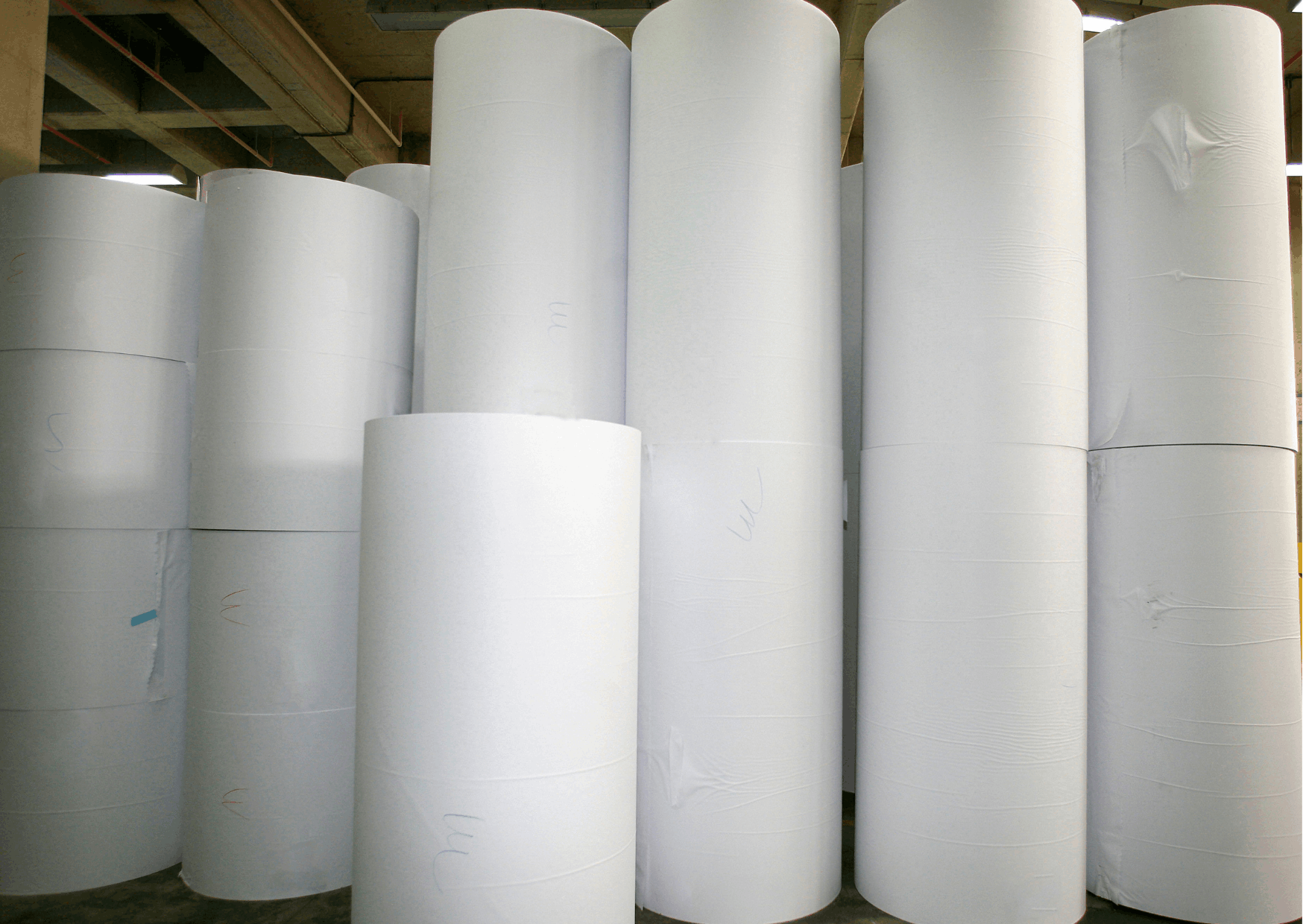
(Eye-to-sky stacking)
Apart from container considerations, orientation also impacts cargo performance. The term “eye-to-sky” (core to sky) is the industry’s preferred position of loading paper. In this position, the eye (or the core) is placed vertically, and as the term suggests, towards the sky. When oriented in this position, the strong structural axis allows for even weight distribution, thereby reducing deformities and condensation drips. Although rolls are also transported in a lying-down position, with properly sized wedges and anti-slip mats to prevent rolling.
How it Moves and How it Stays
While storing and transporting have their own challenges, handling also plays a decisive role in maintaining cargo integrity. Paper rolls are massive, dense, and heavy – weighing between one and five tonnes – and using the proper equipment is practically non-negotiable. Forklifts are commonly required to be fitted with roll clamps when handling industrial rolls, or with tissue roll clamps for more delicate tissue products. Rubber clamps are also used for additional grip, albeit with lower pressure. Clamp choices are critical because incorrect grip or force can cause irreparable damage to the cargo. Even lashing requires special attention when handling paper cargo. Most paper cargo is secured with soft woven polyester belts, with edge protectors to prevent damage to the outer layers.
Finally, vessel selection also matters. Specialized Forest Product Vessels (S-Types) were developed in close collaboration with the paper industry and are well-suited for such shipments. These vessels are fitted with side-loading elevators, box-shaped holds with no under-stow, and advanced dehumidifying systems in holds to prevent moisture damage. While container ships and multi-purpose are also used, purpose-built tonnage can often deliver the lowest damage ratio.
It is remarkable how many considerations we are confronted with on a day-to-day basis within the pulp and paper industry, and how every cog in the wheel, from the producers, handlers, forklift drivers, carriers, logistics providers, workers on the vessels and on the docks, and in the warehouses, the number crunchers, and the market observers, all have a singular goal in mind: to make sure that paper does not tear.
Share on:


.svg)


